
The costs for the internet have been reducing significantly year-on-year (YoY), while MPLS costs stagnate. Gartner envisions a hybrid WAN – a situation where customers have the choice to bond cheaper internet links with premium links to reap the benefits from both worlds while still achieving secure, resilient & highly scalable WAN networks. With more and more services moving to the cloud and changing branch user demands, traditional & rigid WAN networks with a single focal point are becoming a bottleneck as more and more services continue to be distributed between production DCs, DR sites, multiple clouds & branch sites.

As part of the software-defined data center (SDDC) drive, Riptide is delivering Citrix SD-WAN, a technology that is enabling customers to take advantage of the wide choice of link types available in the market today (MPLS, Internet, Microwave, 4G, Satellite, etc.) to build resilient Hybrid WAN networks while reducing overall WAN costs. 

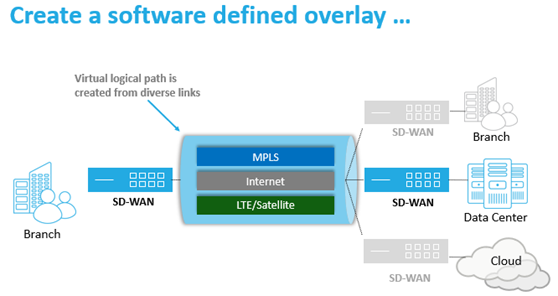
Using SD-WAN, customers can now create ‘fat pipes’ from the diverse WAN links available today to achieve a secure always-on branch network whereby users enjoy the aggregated total bandwidth available (Active-active).

Citrix SD-WAN’s concept of creating a virtual MPLS increases the performance, reliability, and security for traditional enterprise applications, SaaS applications, and virtual desktops over any network while simplifying the branch network.
 

SD-WAN features and benefits?


  • Bond links – Combine different links (MPLS, internet, Microwave, Satellite, LTE, WiMAX, etc.) into one aggregated pipe to utilize all the total bandwidth available (Active-active links).
  • AlwaysOn Branch – Maintain high performance for mission-critical apps, even when a network link fails. 
  • Intelligent path selection for each packet depending on individual link metrics (latency, loss, jitter & loss) – We monitor packet by packet to determine the best route and react in milliseconds to link changes/degradation. We react within milliseconds losing max 4 packets if any link misbehaves.


  • No idle capacity – Achieve true Active-Active capability on redundant WAN links enabling utilization of all available bandwidth through link virtualization. Traditionally most customers have active-passive WAN setups.
  • More bandwidth -Reduce overall WAN costs and increase branch bandwidth by bonding cheaper internet links with your premium links e.g. MPLS 1+MPLS 2 or completely do away with MPLS links – Internet1+Internet2 or Internet1+4G – while still guaranteeing high SLAs to the business.
  • Application QoS – Deliver QoS on the bonded/fat pipes to ensure the prioritization of business-critical application traffic. Gain visibility into application delivery in order to proactively manage the user experience.
  • Gain comprehensive & real-time alerting & reporting on link provider performance and flag SLA breach. Regain control, freedom, and visibility of the WAN network with the ability to monitor & easily onboard new providers and avoid long-term MPLS vendor lock-in situations.
  • Secure data across the WAN and to the cloud with strong encryption, application-level security policies and data segmentation.
  • Introduce branch firewalling ability. Optionally achieve secure internet break-out from the branch to avoid unnecessary back-haul of some internet, cloud or SaaS applications traffic e.g. Office365 traffic, Salesforce, Google Apps, Facebook, and other leisure traffic.
  • Packet duplication – For VOIP and other such apps that are sensitive to packet loss, you can react with lossless failover to secondary links in case any ISP link has any latency, congestion, jitter or loss events.